I’ve been away for quite some time (life happens, you know), and I’ve missed all the new “challenges” that have been thrown into the platform. And there seem to be quite a few of them too, some of which I haven’t figured out yet.
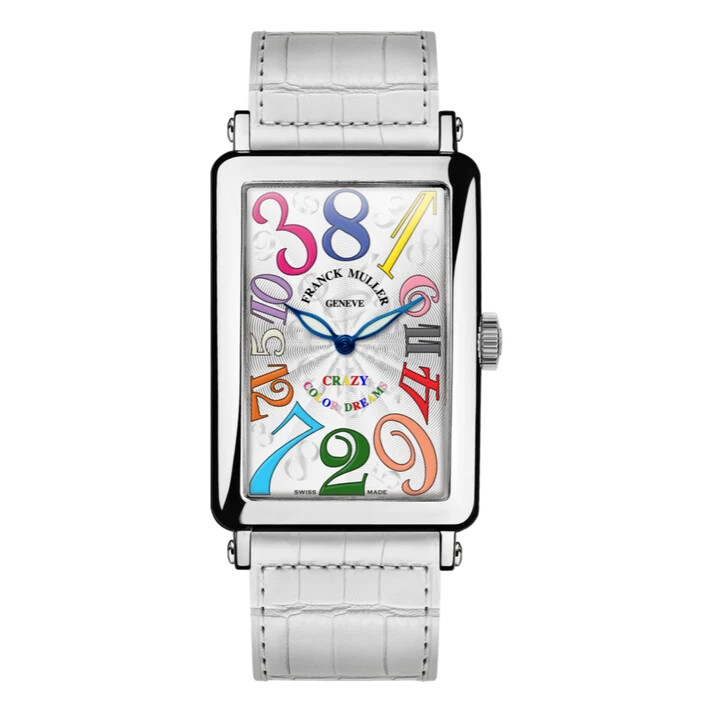
So… I came across the photo of a contemporary watch with a crazy dial layout (and a crazy price, courtesy of Franck Muller), with the hours placed in a seemingly random fashion. This photo woke me up, it kept making me think how a layout like that could be implemented on here without using 12 sets of if-then-else conditionals for the hours hand rotation. I tried many different ideas in Excel, none of which worked.
So with my tail between my legs I resorted to ChatGPT, asking it this:
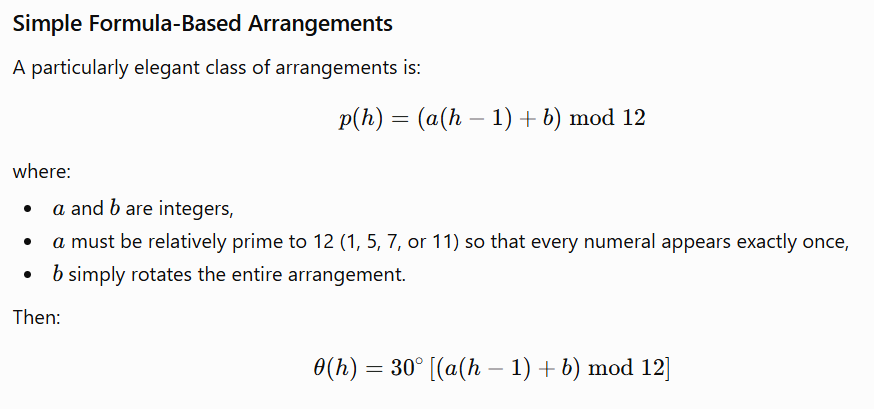
Is there a way to scatter the numerals around a watch face (in the usual 30 degree increments) in such a way that a formula can be used to determine their angular position based on the actual hour?
And this screenshot was its response:
I went back and forth with this in Excel, until it started to work in tests I was doing. I picked 5 for the prime, made a new table in Excel listing actual hours, and calculated where their “whimsical” position would be – and that gave me the dial layout that you can see here, entirely defined by the formula.
Next, based on ChatGPT’s response and the tests I ran, the hours hand (which has to be a “jump hour” hand for obvious reasons) came out to be:
(30 * ((5*(#DK#%12)+1)%12))
Now, I don’t know if Marvelous Marvin will reject this face, but that crazy watch photo fascinated me and I had to make a variation of it and try it for myself into a working model.
6 Likes
Nice one. And good to see you back.
I think somebody asked for something like that on facebook few years ago, so I took it as chalenge. I simply looked at that crazy dial and noticed pattern, one was on usual place and each next digit was 5 usual places ahead.
The hour hand formula maybe was simpler, I think ((#DWFK#)*5+240)
3 Likes
Yes challenge is the right word, for me this was both a technical fascination and a challenge! And a challenge is how I started with all this from the very beginning with the “satellite” face, when I knew nothing at all.
But yes pattern is what helps. The pattern you described is simpler to implement. Staring at the original Franck Muller photo and playing with tables and calculations in Excel, I could only see a pattern but I wasn’t able to formulate it. That pattern has 1, 4, 7, and 10 (every other 3 hours) in their original place, and the rest are either 4, 8, -4, or -8 offset. I couldn’t figure out the pattern.
1 Like
Oh and as far as the dial design, I wasn’t sure whether to keep all digits the same size, or use 4 different sizes like you see here, where diagonally the sizes match (it’s a crazy face after all!). In the original watch, the digit size is constrained by the rectangular space and works very well there.
1 Like
I made me a western style variant of the totally crazy face, with date dial also jumping around.
1 Like
Yes, nice to hear from you…!
I have come across this also, but put it away thinking it’s not my thing. I prefer readable dials…
But yes I recall something around a pattern, ah yes just found Peter’s crazy hours watch face …
1 Like
Very nice creative idea!. Here’s a challenge for you: how about a 2.0 version with a randomly moving minute hand?
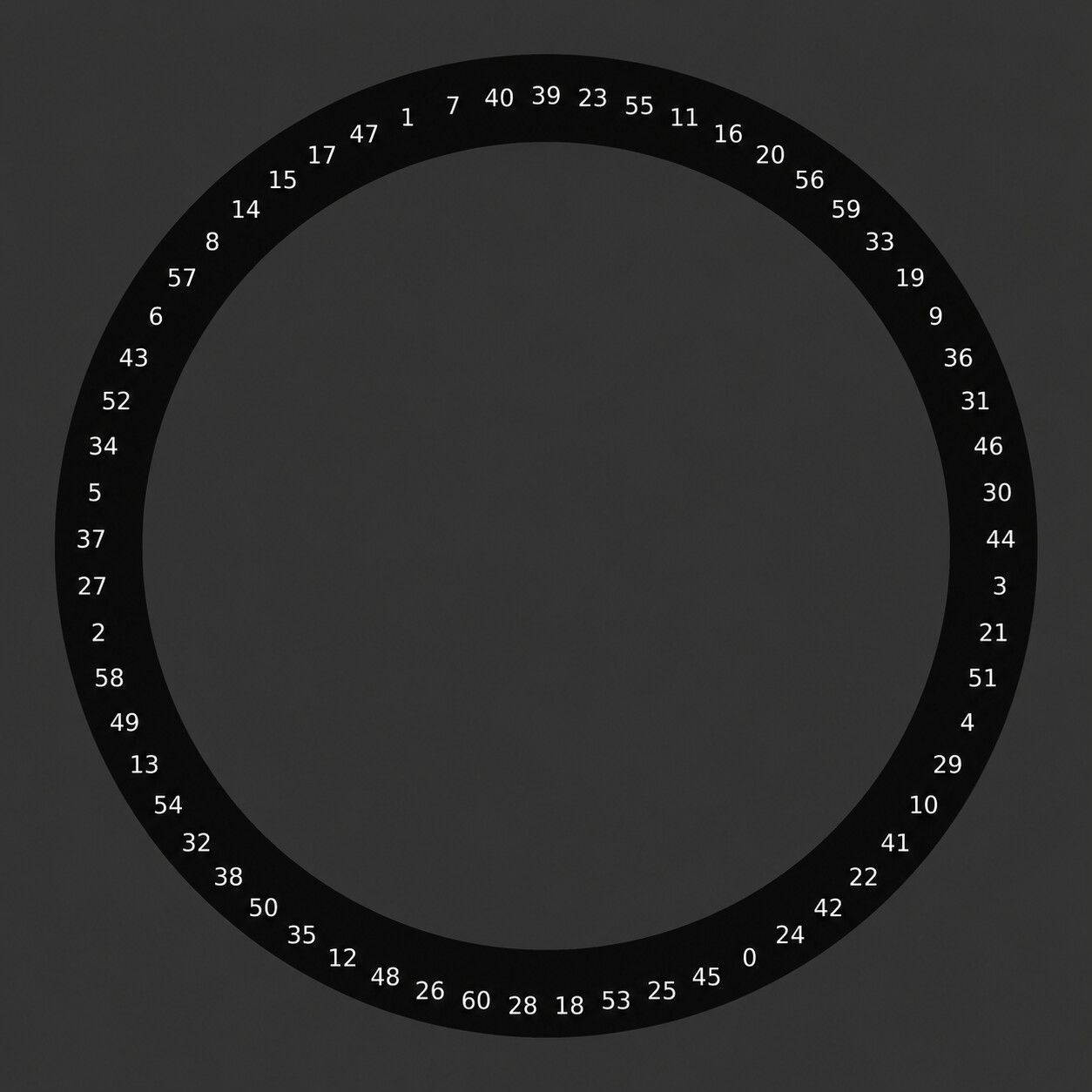
I did not see a pattern in this one 
And there are actually 61 numbers…
So the only rotation I came up with is:
$#Dm#=0?153.4:$$#Dm#=1?342.2:$$#Dm#=2?259.6:$$#Dm#=3?94.4:$$#Dm#=4?112.1:$$#Dm#=5?277.3:$$#Dm#=6?300.9:$$#Dm#=7?348.1:$$#Dm#=8?312.7:$$#Dm#=9?59:$$#Dm#=10?123.9:$$#Dm#=11?17.7:$$#Dm#=12?206.5:$$#Dm#=13?241.9:$$#Dm#=14?318.6:$$#Dm#=15?324.5:$$#Dm#=16?23.6:$$#Dm#=17?330.4:$$#Dm#=18?177:$$#Dm#=19?53.1:$$#Dm#=20?29.5:$$#Dm#=21?100.3:$$#Dm#=22?135.7:$$#Dm#=23?5.9:$$#Dm#=24?147.5:$$#Dm#=25?165.2:$$#Dm#=26?194.7:$$#Dm#=27?265.5:$$#Dm#=28?182.9:$$#Dm#=29?118:$$#Dm#=30?82.6:$$#Dm#=31?70.8:$$#Dm#=32?230.1:$$#Dm#=33?47.2:$$#Dm#=34?283.2:$$#Dm#=35?212.4:$$#Dm#=36?64.9:$$#Dm#=37?271.4:$$#Dm#=38?224.2:$$#Dm#=39?0:$$#Dm#=40?354:$$#Dm#=41?129.8:$$#Dm#=42?141.6:$$#Dm#=43?295:$$#Dm#=44?88.5:$$#Dm#=45?159.3:$$#Dm#=46?76.7:$$#Dm#=47?336.3:$$#Dm#=48?200.6:$$#Dm#=49?247.8:$$#Dm#=50?218.3:$$#Dm#=51?106.2:$$#Dm#=52?289.1:$$#Dm#=53?171.1:$$#Dm#=54?236:$$#Dm#=55?11.8:$$#Dm#=56?35.4:$$#Dm#=57?306.8:$$#Dm#=58?253.7:$$#Dm#=59?41.3:$$#Dm#=60?188.8:$
1 Like
btw. @kvansant also has an interesting “wandering jump hours”:
1 Like
Nice one, 61 numbers! You really can’t rely on AI these days  But I hope you at least used it to create the formula… or did you go old school with a good old protractor?
AI told me there is no pattern, hence no formula…
I used Excel to generate the number matching the degrees, then added the Facer code:
|
Min |
|
Angle |
|
| $#Dm#= |
0 |
? |
153.4 |
:$ |
| $#Dm#= |
1 |
? |
342.2 |
:$ |
Then exported it to a CSV and concatenated all into a single line.
I guess that is old school.
1 Like
Ah ok good one. but Tom “AI told me there is no pattern“… I already told you that in my text, do not need AI for that
1 Like
Now that would definitely be a good challenge for a long-winded conditional formula… but it’s too randomly crazy and exactly why I wanted my hours layout to be formula-driven. My Roman numerals face has long-winded conditional formulas for its minutes and seconds (61 each).
2 Likes
Why export to CSV and concatenate, instead of concatenating right in Excel?
BTW… one of the “changes” I’ve notice since I came back: an inordinate number of people following me, almost all of them with usernames that are FacerUser-xxxxxx with random numbers, almost all of them are accounts who only follow on average 4 people, and almost everyday I’m getting 5-10 new ones. What is going on?!
BWT #2: looks better with uniform sized numerals. Not sure why I ever bothered with varying size.
I do not master Excel… so use what I know…
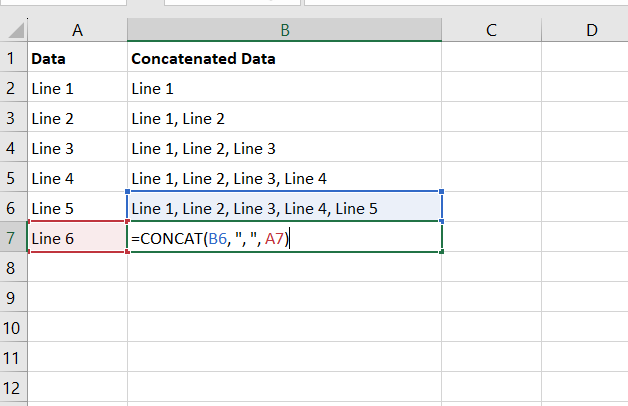
This is how I do it: B2 is just the same as A2, then starting with B3 and going down I concatenate what’s in the cell above with what’s in the cell to the left.